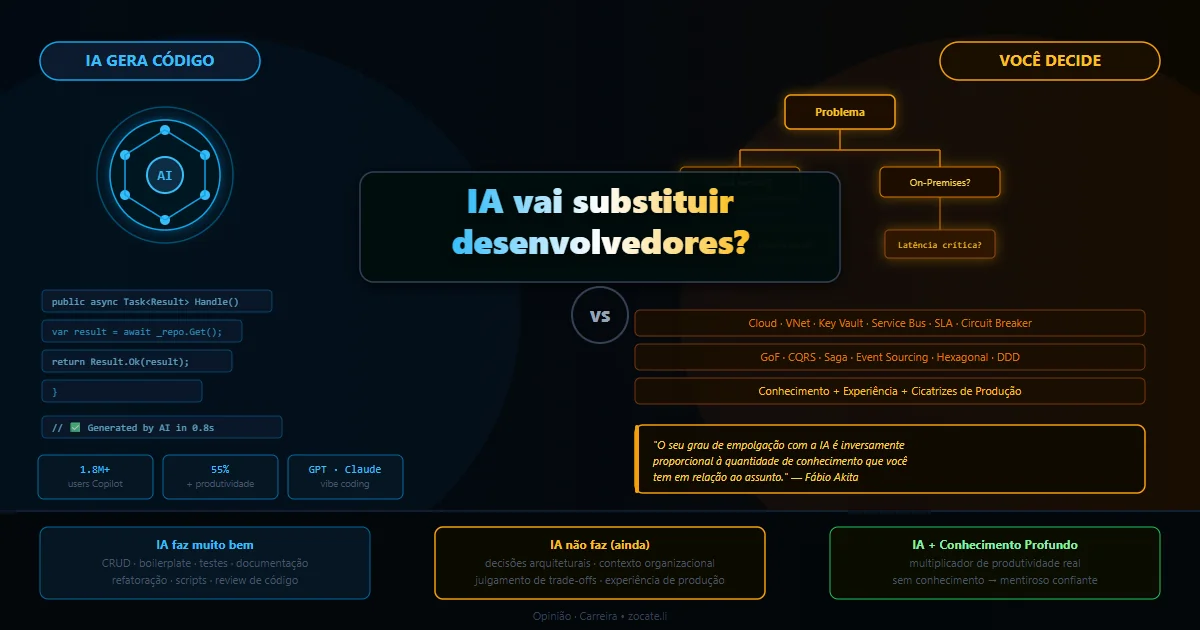
“Your level of excitement about AI is inversely proportional to how much you know about the subject.”
— Fábio Akita
That sentence hit me hard the first time I heard it. Not because it was new — I had already felt it empirically. But because Akita put into exact words what I silently observed every time someone told me that AI “will change everything” or that in two years there will be no more developers on the market.
I’ll be direct: AI will not replace my job. But I won’t use that statement as a shield of corporate arrogance. I’ll explain the reasoning — with data, with honesty, and with the awareness that, for a real slice of the market, the replacement is already happening.
The context that can’t be ignored
The numbers are real and deserve respect:
- GitHub Copilot has more than 1.8 million paid subscribers (GitHub Octoverse 2024). In companies that adopt it, developers report between 20% and 55% productivity gains on coding tasks.
- Cursor, the AI-based editor, went from zero to more than 360 thousand active users in less than two years. In recent funding rounds it was valued at more than US$2.5 billion.
- Language models such as Claude 3.5 Sonnet, GPT-4o and Gemini 2.0 now pass technical benchmarks that would have been impossible two years ago: they generate unit tests, architect complete modules, debug stack traces and refactor legacy code with senior-level quality on well-scoped tasks.
- The concept of vibe coding — coined by Andrej Karpathy in February 2025 — describes a new way of building software: you describe what you want in natural language, the AI generates it, you adjust it by feel, without necessarily understanding what was produced.
Vibe coding is real. It is productive in certain contexts. And that is exactly where the danger lies.
What vibe coding delivers well
For projects with a controlled scope — an automation script, a simple CRUD, a landing page, a demo prototype — vibe coding delivers fast. Really fast. A person with prompt engineering skills can achieve in hours what would take days in the traditional model.
That has value. I won’t downplay it.
What vibe coding doesn’t deliver
Vibe coding does not deliver decisions. It delivers code that looks like it works. Sometimes it really does work. Sometimes it works in the developer’s context but fails in production under load, with real data, at peak time on a Tuesday at 2 p.m. when the sales team pushed an unplanned campaign.
AI doesn’t know that the database is in a private VNet on Azure and that the connection string can’t be passed as a plain text environment variable because the company’s compliance policy requires Key Vault. AI doesn’t know that a third-party API has a limit of 100 requests per minute and that the solution it generated will blow up in production in less than 15 seconds. AI doesn’t know that the company tried a similar approach two years ago and the result was an incident that lasted 4 hours.
I know. Because I was there.
Why specifically I won’t be replaced
Let me be precise. It isn’t vanity — it’s analysis.
1. My main job isn’t writing code
Writing code is a means, not an end. The end is delivering a solution that works within the real constraints of a real system — constraints of cost, performance, compliance, deadlines, and the capacity of the team that will maintain it.
Most of my professional value lies in questions that come before any line of code:
- Does this problem need to be solved with code? Or is there a managed service that already solves it?
- If I’m going to use a cloud service, which SLA tier fits the planned budget?
- Does this microservice need strong consistency, or is eventual consistency enough? That decision changes everything.
- Are we putting critical business logic in a layer that will change every time the cloud provider releases a new version of the function?
AI generates code for any of these choices. It doesn’t have the context to make the choice.
2. Knowing cloud services — for real
There is a huge difference between knowing a service exists and knowing how to use it well.
Knowing that Azure Service Bus exists: AI knows that. Knowing that messages with an expired TTL go to the Dead Letter Queue and that, if you don’t consume it, it will pile up and eventually trigger capacity alerts that will wake someone up at 3 a.m.: that is production experience.
Knowing that AWS Lambda has cold starts: AI knows that. Knowing that in a certain context with intermittent loads the cold start of a .NET function can make the P99 latency unacceptable for the contracted SLA — and that the solution isn’t provisioned concurrency but rethinking the service architecture — that is judgment that comes from having been wrong before.
The cloud ecosystem is gigantic and constantly changing. Azure, AWS and GCP each have hundreds of services, each service has quirks, limits, gotchas, and unexpected interactions with other services. Accumulated knowledge about that ecosystem can’t be replaced by a model that was trained up to a certain date and that frequently hallucinates configuration details with absolute conviction.
3. Knowing multiple technologies — and knowing which one to use
It isn’t about knowing everything. It’s about having a mental map good enough to recognize which tool serves the problem.
When someone brings me a database read performance problem, I have a repertoire of approaches — distributed cache, read replica, precomputed events, CQRS, strategic denormalization, keyset pagination — and I know from the context which of them makes sense. Not all of them. The one that makes sense here, now, with this team, within this deadline.
AI gives me the options. Sometimes it lists them well. But it doesn’t carry the weight of context. It doesn’t know that the maintenance team is small and that introducing event sourcing now will create an onboarding problem that will cost more than the problem it solves.
4. Architectural decisions: what works vs. what looks right
This is the hardest part to explain to someone who hasn’t lived it, and the most important one.
There are elegant architectural patterns — CQRS, Event Sourcing, fine-grained microservices, hexagonal architecture — that are technically correct, academically defensible, and disastrous in certain organizational contexts.
A team of 3 devs maintaining a legacy financial system won’t benefit from a rewrite into asynchronous microservices with event sourcing and a distributed messaging platform. It will produce a system that’s impossible to debug, with operational complexity the team can’t absorb, and it will create a new kind of technical debt where there used to be the old kind.
Knowing when not to apply a pattern is as valuable as knowing how to apply it. That isn’t in the books. It’s in the scars.
AI has no scars. It has tokens.
The confident liar problem
There’s a dynamic I observe frequently — and that genuinely worries me about the market:
AI is a confident liar to anyone without deep knowledge.
I don’t use “liar” as an insult to the model. I use it as a precise technical description: an LLM generates the most probable answer given the context, not the most correct answer. When the space of possibilities is vast and the user has no way to evaluate the quality of the answer, the model can — and frequently does — generate incorrect information with the same tone, the same formatting and the same apparent confidence as when it is right.
That is dangerous when you don’t have the knowledge to tell the difference. And it is extremely productive when you do.
| |
AI doesn’t replace human work in programming, but it amplifies the ability of whoever programs. It doesn’t turn a weak professional into a better one — it only helps produce weak results faster. In the hands of an experienced developer, however, AI becomes a powerful accelerator, making it possible to deliver high-quality code at a pace that used to require entire teams.
I’ve seen experienced architects use Claude to generate code skeletons in minutes — and then review them, adjust them, discard parts and produce something solid in half the time it would have taken without the tool. AI works as a multiplier of what they already know.
I’ve seen junior developers use the same tool to generate code that passed every local test, went to production, and caused a silent N+1 problem that only showed up under real load — because they didn’t know what to ask, didn’t know how to review, and didn’t have the repertoire to identify that the code was wrong even when it looked right.
Who should worry — and about what
I’ll be honest about what worries me:
Highly repetitive, well-scoped tasks are being absorbed by AI. Basic CRUD, unit tests for simple code, documentation, data transformation scripts, boilerplate code. That is real. It is happening now.
What does that imply? Probably two things:
Demand for developers with a low level of specialization will decrease. Those who positioned themselves in the market as “I write the code I’m asked to write” will feel the pressure. Not because AI is a better programmer — but because it is cheaper for that kind of task.
Demand for developers who make decisions will increase. As the speed of code production increases, the need for people who know what to produce, in which order and with which architecture grows proportionally.
The market won’t need less thinking. It will need less typing.
And the thinking — contextual judgment, the experience of having failed in specific ways, the knowledge of how different pieces fit together in real systems — is still human.
For now. I won’t pretend that “for now” is forever. But we are far from a model that replaces contextualized technical judgment. And for as long as that takes, investing in deepening real knowledge remains the best strategy.
What to do about it
If you are at the beginning of your career or looking to reposition yourself:
Don’t use AI as a substitute for learning. Use it as a learning accelerator.
There is a critical difference between using AI to generate code you are going to study and understand — and using AI to generate code you are going to ship without understanding. The first approach makes you better. The second creates an illusion of proficiency that will reveal itself at the worst possible moment.
Learn the fundamentals AI assumes you already know: how distributed systems fail, how databases work internally, how cloud services really behave under load, what makes an architecture sustainable versus what only looks elegant on the diagram.
That knowledge doesn’t become obsolete when a new AI model comes out. It becomes more valuable.
Conclusion
AI is the most powerful tool I’ve had in my hands in 20 years of career. I use it every day. It makes me more productive in ways that wouldn’t be possible without it.
But it is a tool. An extraordinary tool in the hands of someone who knows what they are building. And a tool that generates baseless conviction in the hands of someone who doesn’t.
My differentiator isn’t typing code faster. It never was. It is knowing — after years of experience, mistakes, incidents, painful refactorings and decisions that worked — what to build, when, how and why.
AI doesn’t do that for me yet. And as long as it doesn’t, my job remains mine.
Read Also
- GitHub Copilot: AI Agents, Models and Complete Guide
- Software Architecture: GoF, Patterns and Microservices
- The Pragmatic Programmer: practical lessons from the book
- REST API Design: HTTP Verbs and Parameter Binding
References
- Andrej Karpathy — “Vibe Coding” (Twitter/X, February 2025) — Original definition of the vibe coding concept by the creator of the term
- GitHub Octoverse 2024 — Data on Copilot adoption and impact on productivity
- GitHub — Research: Quantifying GitHub Copilot’s Impact — Study on productivity gains with Copilot
- Fábio Akita — YouTube channel — Technical and career analyses (in Portuguese), including episodes about AI and the development market
- DAIR.AI — Prompt Engineering Guide — Technical guide on prompt engineering and the limitations of LLMs
- Gartner Hype Cycle for Emerging Technologies 2024 — Positioning of generative AI in the technology hype cycle
By commenting, you agree to our Privacy Policy, Terms of Use, Data Deletion Policy.