
Introduction
The book’s title caught me before I even opened the first page. The Digital Cretin Factory (La Fabrique du crétin digital). It is not a self-help title. It is not blog clickbait. It is the title that Michel Desmurget — neuroscientist, research director at INSERM (Institut National de la Santé et de la Recherche Médicale, the French equivalent of the American NIH) — chose after decades of studying children’s neurological development and synthesizing more than 2,000 peer-reviewed scientific studies.
The discomfort was immediate. Not because I feel attacked as a parent or as a citizen. The discomfort came from somewhere else: I am a software developer. I build systems. I design APIs. I define architectures. And part of what this book criticizes was built by people exactly like me — competent professionals, with good intentions, who never stopped to ask whether what they were building was good for the people who would use it.
The Digital Cretin Factory is not a book about technology. It is a book about what technology — in the form and volume in which it is consumed today — is doing to the cognitive development of children and teenagers. And Desmurget’s argument is neither moral nor nostalgic. It is scientific, rigorous and, precisely for that reason, very hard to counter with the old “but kids today are smarter”.
I am not going to write a review. Reviews exist. What I will do here is explain why this book made me uncomfortable as an IT professional, where Desmurget’s arguments meet the decisions I make in my work, and what — if anything — I can do differently. If you have read The Phoenix Project and identified with the feeling that IT has a systemic problem, brace yourself: Desmurget expands the scope of that problem beyond our organizations.
The Digital Native Myth
I will start with the most comfortable lie our industry has embraced: the idea of the digital native.
The concept was coined in 2001 by Marc Prensky in an article called “Digital Natives, Digital Immigrants”. Prensky was — and is — an education consultant and educational game designer. Not a neuroscientist, not a developmental researcher, not someone trained in cognition or neurology. He created the term to argue that the generation born surrounded by technology processed information differently from previous generations — and that, therefore, the education system needed to adapt.
The idea stuck. It made its way into corporate speeches, public education policies and justifications for putting tablets in classrooms. It became the argument the technology industry repeats most because it is exactly what the industry needs us to believe: that more technology from an early age is evolution, not a problem.
What Desmurget shows, study after study, is that this belief has no scientific basis.
No peer-reviewed research has demonstrated that children born into digital environments have superior cognitive abilities because of that environment. On the contrary: the data show a consistent association between more screen time and reduced vocabulary, lower reading ability, IQ scores below what is expected for the age group, difficulty concentrating and delays in oral language in young children.
The irony Desmurget does not let slide is crystal clear: the Silicon Valley executives who build these products send their children to screen-free Waldorf and Montessori schools. Steve Jobs limited his children’s access to the iPad. The creator of Twitter’s infinite scroll, Aza Raskin, publicly regrets the invention. There is something very revealing in knowing that those who build these systems do not use them with their own children.
⚠️ Warning: “Digital native” is a marketing construct, not a neuroscientific one. The concept was created by a consultant with no scientific training in cognitive development and was never empirically validated. Developmental neuroscience says the opposite: the developing human brain needs specific stimuli — rich oral language, deep reading, unstructured play, human interaction — that screens do not provide and frequently replace.
What Screens Really Do to the Brain
Desmurget is precise about something technology critics usually get wrong: technology itself is not the problem. A 16-year-old learning to program, creating digital art or reading books on an e-reader is in a completely different situation from a 2-year-old in front of a tablet autoplaying children’s videos. The problem is the volume, form and age range of exposure.
The human brain does not finish developing at 6, at 10, or even at 18. The prefrontal cortex — responsible for decision-making, impulse control, abstract reasoning and emotional regulation — only completes its development around age 25. It is an organ under construction for a quarter of a century, and what feeds it during that process permanently shapes its connections.
The documented impacts vary by age group:
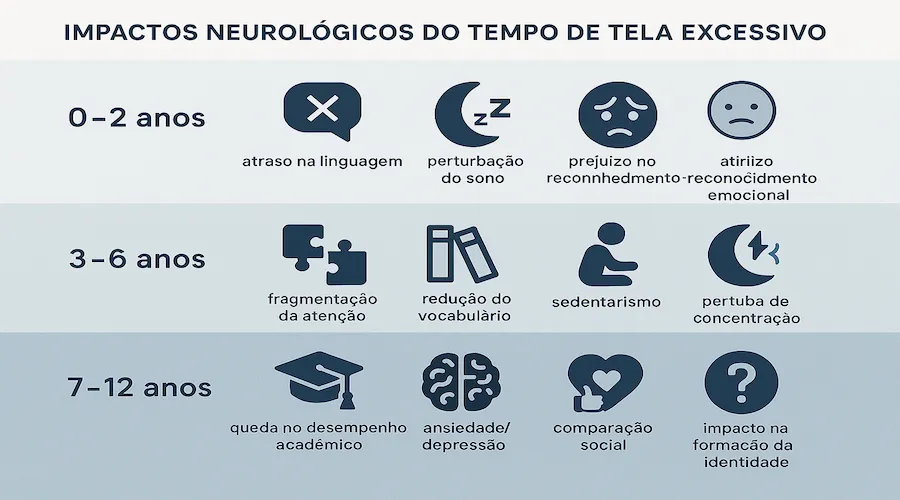
| Age group | Main documented impacts |
|---|---|
| 0–2 years | Delayed oral language, impaired recognition of facial emotions, sleep deprivation, replacement of human interaction |
| 3–6 years | Fragmented attention, reduced vocabulary, lower capacity for sustained concentration, difficulty with symbolic learning |
| 7–12 years | Drop in school performance (especially reading and math), sedentary lifestyle, sleep problems from blue light exposure, lower capacity for deep reading |
| Teenagers | Anxiety, depression, pathological social comparison, dependence on external validation (likes), impact on identity formation, increased risk of self-harm in girls |
The mechanism is not mysterious. The developing brain needs deep reading to build comprehension and abstraction circuits. It needs rich conversations to build vocabulary and theory of mind. It needs unstructured play to develop creativity and problem-solving. It needs quality sleep to consolidate memories and reorganize neural connections.
Passive screens — and most children’s screen consumption is passive, not active — replace these activities without providing equivalent stimuli. It is not that screens are bad in themselves. It is that the hour spent watching YouTube videos is the hour that was not spent reading, playing, talking or sleeping.
ℹ️ Info: The WHO recommends zero screen time for children aged 0 to 1 and no more than 1 hour per day for children aged 2 to 4. The American Academy of Pediatrics follows similar recommendations. These are not opinions — they are consensus built on decades of research. And most parents do not know they exist.
The Attention Economy: How We Built the Dependence
Up to this point, Desmurget is talking about neuroscience. But the book goes further. It points a finger at something most analyses of screens and children avoid naming directly: it is no accident that apps are addictive. It is intentional design.
Let me explain the mechanism, because it matters for what I will say in the next section.
In 2003, B.J. Fogg founded the Persuasive Technology Lab at Stanford. The stated goal was to study how computers could change human attitudes and behaviors. Fogg created the B=MAP model (Behavior = Motivation + Ability + Prompt) — a framework for making behaviors more likely through technology. He was not thinking about children. He was thinking about design. But what he trained was a generation of product designers in how to make people do things they did not plan to do.
Nir Eyal systematized this in the book Hooked (2014): the four-step product model — trigger, action, variable reward, investment — that every startup uses today to create habits. The book is a manual. It sits on the shelf of every self-respecting PM and product designer.
The central element of the model is the variable reward. It is the same mechanism as slot machines: you do not know what you will find when you scroll the feed, when you open notifications, when you swipe to the next video. It could be something irrelevant. It could be something that makes your heart race. The uncertainty is the addiction. Infinite scroll was not a UX solution to avoid clicks — it was the perfect implementation of a casino in every user’s pocket.
Tristan Harris, a former design ethicist at Google, tried to warn the company internally in 2013 with a presentation called “A Call to Minimize Distraction & Respect Users’ Attention”. It did not work. In 2016, he went public with the article “How Technology is Hijacking Your Mind” and founded the Center for Humane Technology. Harris says — and documents — that technology companies are in an arms race for human attention, using persuasion techniques more sophisticated than any user, parents included, can consciously resist.
Who designs these systems?
Us. Devs. Engineers. Software architects.
📝 Example: Every time I implement a “load more on scroll” without offering the user explicit pagination with a clear stopping point, or when I build a push notification system without enough granularity for the user to silence specific categories, or when my application’s default behavior is to maximize screen time instead of delivering value and getting out of the way — I am applying, consciously or not, the principles of the attention economy.
It is uncomfortable to write this. But it is true.
This debate about agency and responsibility is central to how I see my work today. I have already written about how AI is changing the developer’s role — but perhaps the most urgent question is not what AI will do to our work, but what we, with our own hands, have already done.
Do We, Developers, Have Responsibility?
This is the question the book does not answer for me — and that I had to answer on my own.
The honest answer is: yes. But the extent and nature of that responsibility are more complex than a yes or no can hold. I will be direct about the arguments I myself have used to excuse myself — and why none of them satisfies me anymore.
Argument #1: “I just implement what product tells me to.”
It is the most common argument. The PM defined the backlog. Design approved the wireframes. The CEO wants growth in daily active users. I just write code. Responsibility lies with whoever makes the product decisions.
Why it does not hold up: whoever writes the code makes implementation choices constantly. Infinite scroll does not implement itself — someone decided not to add a pause button. A notification system without granular control is not an architectural accident — it is a choice. When I implement something I know will maximize engagement at the expense of the user’s well-being, and I say nothing, ask nothing, propose no alternative, I am making an active decision not to question.
The Pragmatic Programmer I read a few years ago said: take ownership of your code. Ownership is not only about technical quality. It is about the consequences of what you build.
Argument #2: “It is the parents’ responsibility. Nobody forced anyone to give a tablet to a 2-year-old.”
The individual responsibility argument. And it has some merit: parents do have responsibility. But this argument ignores a fundamental detail that Desmurget and Tristan Harris document exhaustively: the systems we build were specifically designed to defeat human resistance to self-control. It is not a coincidence. It is behavioral engineering.
Individually blaming the parent who occasionally hands the phone to a 3-year-old — when the system was designed by teams of psychologists, neuroscientists and engineers to be irresistible — is dishonest. It is like blaming the smoker without mentioning the decades in which the tobacco industry hid research, added ingredients that increased addiction and hired doctors to endorse cigarettes in TV commercials.
In fact, this is exactly the analogy Desmurget uses: big tech funds research that “contradicts” independent studies on the impact of screens, in the same way the tobacco industry funded research that “cast doubt” on the link between cigarettes and cancer for decades.
Argument #3: “I work in B2B / enterprise. I do not build consumer apps.”
This is the argument I used most myself. I build corporate systems — APIs, pipelines, integrations. I have nothing to do with Instagram or TikTok.
But there are two problems. The first: the design patterns we normalize in consumer products migrate to the enterprise. Aggressive notifications, dashboards that maximize usage time instead of delivered value, UX that creates dependence instead of autonomy — these patterns exist in corporate software as much as in social networks.
The second problem is more structural: the technology industry is an ecosystem. Decisions made at consumer big techs shape what is considered acceptable across the entire industry. When I do not question these patterns, when I treat the attention economy as something that “has nothing to do with me”, I contribute to normalizing a culture that has documented consequences.
💡 Tip: Tristan Harris has a TED talk worth 15 minutes of your time: “How a handful of tech companies control billions of minds every day”. If you are a dev and have never stopped to think about the behavioral impact of what you build, it is an honest, non-apocalyptic starting point.
There is no easy answer here. I will not end this section with a manifesto or a list of rules. What I want to say is simpler and more uncomfortable: the question needs to be asked, and it is not being asked. In most companies where I have worked, nobody — in any sprint meeting, in any refinement, in any retrospective — ever asked: “is this behavior we are building good for the people who will use it?”.
Not because people were ill-intentioned. But because that question simply is not part of the standard vocabulary of software development. We need to put it there.
What I Can Do Differently as a Dev
After all this reflection, the inevitable practical question is: so now what do I do with this?
I will not pretend there is a checklist that solves the problem. But there are concrete choices I can make — that any dev can make — without needing CEO approval or an organizational culture change.
Ethical design in practice
The first step is recognizing deceptive patterns when I am implementing them. The deceptive.design catalog documents dozens of them with real examples: roach motels (easy to get in, impossible to get out), confirmshaming (cancellation buttons with guilt-inducing text), interface interference (elements that make it harder to do what the user wants). Most devs have already implemented at least one of these without naming what they were doing.
Recognizing does not mean automatically refusing. It means asking. “Why are we doing it this way? What is the alternative that serves the user equally well?”. Sometimes the answer will be a legitimate business decision. Sometimes it will open a conversation nobody had stopped to have.
Notifications with purpose
Notifications are the most powerful interruption mechanism we have. And the default in most applications is to notify to engage, not to inform. The difference is fundamental: a notification that informs delivers something the user needed to know. A notification that engages interrupts the user to bring them back to the app regardless of whether they need to be there.
When I design a notification system, the question I now ask is: “would the user be grateful to receive this now, or annoyed?”. If the honest answer is the latter, the notification needs to be rethought.
Digital well-being APIs you can use
There is no need to reinvent the wheel. There are native APIs that let the developer work in the user’s favor:
- iOS: Screen Time API / Family Controls framework — lets apps offer time controls and restrictions that users configure for themselves
- Android: Digital Wellbeing API — access to device usage metrics so the app can self-regulate
- Web: Page Visibility API — lets you automatically pause content when the user is not looking at the tab, instead of continuing to play
Design for exit
Making it easy for users to leave your application is not an anti-pattern — it is respect. A visible close button. Subscription cancellation without 6 confirmation screens. Clear feed control. Privacy settings reachable in one click, not buried in submenus.
Metrics beyond daily active users and screen time
When the PM asks for “more daily active users” or “more average session time”, those metrics measure how much the user is using the app — not whether they were satisfied. Questioning metrics is not being difficult. It is asking what real value we are delivering. Meditation apps, for example, should measure whether users are sleeping better, not whether they spent more time inside the app.
⚠️ Warning: Implementing deceptive patterns is not technically neutral. It is a choice with documented behavioral consequences. You do not need to be absolutely certain it is wrong to raise the question before implementing it. Doubt alone is enough to justify a conversation.
If you want to dig deeper into the ethical dimension of software engineering, the book The Pragmatic Programmer has an entire chapter on professional responsibility that I now read with different eyes.
Tips and Good Practices
Read the book — The Digital Cretin Factory is available in Portuguese, the edition I read, and in its original French. It is not a dense academic text. It is accessible, direct and disturbingly well-grounded. It is a weekend read that will change how you look at what you build.
Get to know the Center for Humane Technology — humanetech.com has practical resources, an ethical design framework and the podcast Your Undivided Attention, which Tristan Harris hosts with experts in cognition, politics and technology. It is not an anti-tech group — it is a group that believes better technology is possible.
Audit the deceptive patterns in your product — use the deceptive.design catalog as a reference. Set aside an hour to review your product with this lens. You will recognize things you implemented yourself without naming what they were.
Propose well-being metrics — engagement measures how much time the user spends in the app, not whether they were satisfied or whether the product delivered value. Ask your product team: which metric captures real value delivered to the user? It is a conversation few teams have ever had.
Have the conversation with the team — it does not need to be a speech or a manifesto. One question is enough: “is this behavior we are building good for the user or only for our KPI?”. Planting the question is already enough to start a culture change.
Separate children from adults in your design — if your product can be accessed by minors, the responsibilities reach another level. Beyond the ethical implications, there are legal obligations: COPPA (Children’s Online Privacy Protection Act, in the US), LGPD (Lei Geral de Proteção de Dados, in Brazil) and GDPR (in Europe) have specific provisions on minors’ data. Ignoring this is not only an ethical issue — it is legal risk.
Conclusion
I am not anti-technology. That needed to be said explicitly, because any critical reflection on the impact of screens tends to be framed that way. I am a developer. I make my living from technology, I believe in what it can do, and I chose this career because I am genuinely interested in building things that work well.
But reading The Digital Cretin Factory forced me to separate two things I treated as synonyms: believing in technology and believing that anything we build with technology is neutral or beneficial by default. It is not.
What Desmurget argues — and what the data he presents support — is that over the last two decades the technology industry created an environment optimized to maximize engagement regardless of the human cost. Not out of collective malice. But because of economic incentives that were never questioned with the necessary seriousness, because those who could question them — the very professionals who build these systems — were never encouraged to ask that question.
The parallel with what I wrote about The Phoenix Project is unavoidable. There, Parts Unlimited’s IT was not destroying the company out of malice — it was destroying it out of systemic ignorance, wrong incentives and a lack of vocabulary to name the problem. Here, the situation has an extra layer: the problem is documented, the vocabulary exists, and the question simply is not asked.
Ten years from now, when you look back at what you built, which sentence do you want to describe your work? “I maximized users’ screen time” or “I built things that delivered real value to the people who used them”?
I know which of the two makes me more comfortable.
If you have read this far and have a different opinion — or if you think I am overstating the weight of the individual dev’s responsibility — leave it in the comments. This debate needs more voices, especially from those inside the industry.
Read Also
- The Phoenix Project: the IT I live every single day
- The Pragmatic Programmer: practical lessons from the book
- Will AI Replace Developers? An Honest Opinion
- AI, LLM, RAG, Agents and MCP: A Professional IT Guide
References
- The Digital Cretin Factory — Michel Desmurget (Goodreads) — the article’s main reference work
- INSERM — Institut National de la Santé et de la Recherche Médicale — the institution where Desmurget is a research director
- Center for Humane Technology — organization founded by Tristan Harris with ethical design resources and the podcast Your Undivided Attention
- WHO: Guidelines on physical activity, sedentary behaviour and sleep for children under 5 years of age — World Health Organization guidelines on screen time by age group
- American Academy of Pediatrics — Where We Stand: Screen Time — American Academy of Pediatrics recommendations by age group
- TED Talk: Tristan Harris — How a handful of tech companies control billions of minds every day — essential talk on the attention economy (15 min)
- Deceptive Design — Hall of Shame — catalog of deceptive patterns with real examples identified in well-known products
- At a Waldorf School in Silicon Valley, Technology Can Wait — NYT — report on Silicon Valley executives who choose screen-free schools for their children
By commenting, you agree to our Privacy Policy, Terms of Use, Data Deletion Policy.