Introduction
The comparison of the C# language with other modern languages changes a lot when the topic stops being general productivity and becomes complex backend applications, embedded software and high-security systems. For this kind of application, I don’t start by asking which language is the most elegant, popular or fastest to prototype with. I start by asking which stack reduces operational risk, eases auditing, controls memory, sustains long maintenance and lets me prove behavior with tests, static analysis and observability.
My direct answer is this: C#, Java, Go and Rust are the most defensible choices for modern critical cores, each one under a different kind of constraint. C# and Java are very strong in regulated enterprise backends and rich domains. Go is excellent for platform services, networking and operational components that are simple to distribute. Rust is one of the best current options for embedded systems, low-level components and software where memory safety matters more than initial development speed. C and C++ remain present in embedded and real-time systems, but demand much greater discipline to keep flexibility from turning into vulnerability.
This article is a natural continuation of the comparison C#, Go, Python, Java, Ruby and PHP: which one to choose?. The difference is the scope: here I look at applications where a failure can cause a financial incident, widespread unavailability, a security risk, a regulatory breach or unsafe behavior in a physical device. That is why I include TypeScript and PHP in the analysis, but with an uncomfortable question: should these languages be in the core of this kind of application, or only in peripheral layers?
ℹ️ Info: A critical system doesn’t only mean an airplane, a car or medical equipment. A payment authorizer, an identity backend, a banking platform, an infrastructure gateway and a service that controls permissions can also be critical.
I will compare the languages using practical criteria: type of application, execution model, memory safety, concurrency, operational predictability, ecosystem, auditing and maintenance risk. The central thesis is simple: for critical systems, the best language is the one that makes errors harder to write, easier to detect and cheaper to fix.
How to Define a Language for Critical Backend, Embedded and High Security
Before comparing C#, Java, Go, Rust, TypeScript and PHP, I need to separate three families of problems that often get mixed up in the conversation.
A critical backend is the system that supports business rules, external contracts, identity, authorization, payments, messaging, auditing and integration between domains. It can run on Kubernetes, virtual machines or managed services, but its main characteristic is the impact of failure. If the backend loses consistency, accepts an invalid transaction or exposes sensitive data, the problem is not only technical: it becomes a legal, financial and reputational problem.
Embedded software is a different game. Here we have firmware, controllers, industrial devices, edge gateways, professional IoT, automotive, medical equipment and systems with CPU, memory, power or real-time constraints. Embedded does not mix well with heavy runtimes when the target is a small microcontroller, predictable boot or fine-grained memory control. The question stops being “which web framework do I use?” and becomes “which language lets me control hardware, memory and response time without opening a crater of vulnerabilities?”.
High security is a cross-cutting property. It requires threat modeling, strong authentication, explicit authorization, correct cryptography, auditable logs, a controlled dependency chain, static analysis, code review and incident response. The language helps or hinders this process. A stack with strong types, mature tooling and good integration with SAST (Static Application Security Testing) tends to reduce human error. A stack with fragile dependencies, a runtime that is hard to isolate or inconsistent practices increases the cost of governance.
⚠️ Warning: High security is not born from the language alone. Badly written C# can be insecure; badly designed Rust can leak secrets; modern PHP can be secure in a web portal. The question is which language reduces the number of traps in the specific scenario.
I use four filters for the decision: domain criticality, runtime constraints, team maturity and the need for proof. If the application needs to prove business invariants for years, I value typing and safe refactoring. If it needs to run close to the hardware, I value memory control and an embedded toolchain. If it needs to withstand attacks, I value the security ecosystem, dependency updates and operational isolation.
C# in Complex Backend and Security Applications
C# is one of the most balanced languages for complex backends when the system requires a rich domain, explicit contracts and long maintenance. The modern .NET ecosystem combines an expressive language, a mature runtime, excellent tooling and strong integration with observability, authentication, authorization, testing and cloud. In highly critical enterprise applications, this combination weighs more than terse syntax.
The strongest point of C# for a critical backend is the ability to model rules with types. record, required, nullable reference types, pattern matching, interfaces, generics and analyzers help turn part of the business rules into a compilable contract. This doesn’t eliminate bugs, but it reduces ambiguity. When a financial, tax or regulated domain grows, the difference between “optional field by convention” and “invalid state impossible or rare” shows up in maintenance.
At runtime, the CLR offers a mature garbage collector, an optimized JIT, consolidated async/await and good predictability in web services. ASP.NET Core is competitive in performance, but what matters most to me is operational consistency: structured logs, OpenTelemetry, health checks, integration with identity providers, configuration validation, containers and pipelines are well-documented paths. For systems that need auditing, this reduces friction.
C# also has a good track record in high-security enterprise environments. The ecosystem supports integration with OAuth 2.0, OpenID Connect, mTLS, Azure Key Vault, HSMs via providers, platform cryptography and centralized policies. In a well-designed architecture, C# can be used in the core of authorization, anti-fraud, regulated APIs and transactional services.
The limit appears in small embedded devices and hard real time. .NET can run on embedded Linux, industrial gateways, devices with reasonable resources and edge scenarios. There is also .NET nanoFramework for microcontrollers. But when the requirement is fine-grained memory control, rigorous embedded certification or deterministic real time, I wouldn’t make C# the first choice. In that territory, Rust, C, C++ and Ada/SPARK come in with stronger arguments.
Java, Go and Rust: Three Strong Answers for Different Constraints
Java remains a robust choice for large-scale critical backends. The JVM has decades of maturity, excellent profiling tools, advanced garbage collectors and a strong presence in banks, insurers, telecommunications and transactional systems. With virtual threads, Java became even more interesting for I/O-based concurrent applications, because it removes part of the historical complexity of scaling blocking operations.
I would choose Java when the organization already has JVM governance, large teams, mature processes and a well-established Spring or Jakarta ecosystem. Java is less attractive when the team wants a small service, a simple binary and a minimalist deploy. But in regulated environments, the combination of stability, tooling and the talent market is still very hard to ignore.
Go solves another problem: operational simplicity. It compiles fast, produces binaries that are easy to distribute, has a simple concurrency model with goroutines and works very well for network services, control planes, gateways, workers and infrastructure tools. For a critical backend, Go is strong when the domain is more operational than semantic: routing, ingestion, queues, proxies, orchestration, telemetry and cloud-native components.
Go’s weak point appears in very rich business domains. The language favors simplicity, and that is a virtue, but it can limit modeling expressiveness when the team wants to capture sophisticated invariants in the type system. I wouldn’t rule out Go for critical systems; I would just be careful not to use syntactic simplicity as an excuse to scatter complex rules across if statements and anemic structs.
Rust is the strongest answer when memory safety, allocation control and the absence of a garbage collector are central requirements. The borrow checker prevents entire classes of memory-usage bugs at compile time. In embedded systems, low-level components, cryptography, parsers, engines, local agents and edge software, Rust has a very serious proposition: delivering performance close to C/C++ with better guarantees against human error.
The cost of Rust is the learning curve and initial speed. For a team without experience, Rust can delay deliveries at first. Even so, when the software will live for many years, receive hostile input or run in a sensitive context, this initial cost may be lower than the cost of memory vulnerabilities in C/C++ or the operational overhead of higher-level runtimes.
C, C++ and Ada/SPARK Still Matter in Embedded and High Assurance
In modern discussions, it is common to talk about C#, Java, Go, Rust, TypeScript and PHP and forget that a huge part of the critical world still runs on C and C++. Automotive systems, firmware, drivers, industrial equipment, telecommunications and medical devices carry decades of code in these languages. Ignoring this would be naive.
C offers extreme control, a small footprint and direct hardware access. For microcontrollers and very constrained environments, it remains the dominant choice. The problem is that C also offers very few protections by default. Buffer overflow, use-after-free, integer overflow and undefined behavior are not academic details; they are real causes of vulnerabilities and failures. That is why C in a critical system must come with MISRA C, CERT C, static analysis, rigorous review, integration tests with hardware and a strict dependency policy.
C++ expands abstraction and performance, but increases complexity. In experienced hands, it enables efficient modeling, RAII, templates, robust libraries and high-performance code. In less disciplined hands, it becomes a dangerous mix of styles, pointers, implicit ownership and behavior that is hard to audit. Modern C++ can be a good choice, but I would require clear internal standards, sanitizers, static analysis, guidelines and specialized review.
Ada and SPARK show up less in popular conversations, but remain relevant in high assurance. Ada was designed with a focus on reliable systems, and SPARK allows formal proof of properties in a subset of the language. In sectors such as aeronautics, defense and systems with heavy certification, this kind of tool can be more important than market popularity.
Rust comes in as a modern bridge in this scenario. It does not yet automatically replace C and C++ across all embedded legacy, but it is increasingly defensible for new components that require memory safety. For embedded gateways running Linux, edge agents and components that process untrusted data, I would look at Rust before writing new C without need.
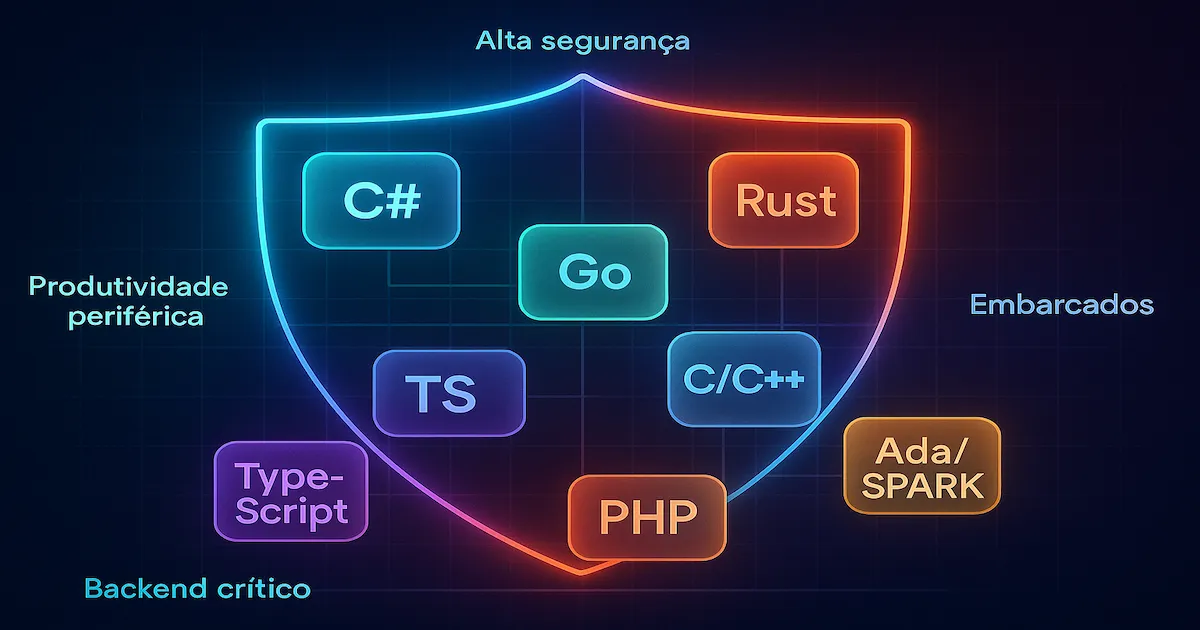
Figure: suitable languages change according to the dominant axis: domain, hardware, memory safety or peripheral productivity.
Should TypeScript and PHP Stay Out of the Critical Core?
TypeScript and PHP deserve an honest analysis because they are widely used in the market and solve real problems. The question is not whether they are “good” or “bad” languages. The question is whether they are suitable for the core of complex applications aimed at critical backend, embedded and high security.
TypeScript is excellent for frontends, BFFs (Backend for Frontend, a backend layer specific to a frontend experience), lightweight automations, product APIs and services in the Node.js ecosystem. Gradual static typing greatly improves the experience compared to plain JavaScript, and the ecosystem is huge. In modern web products, TypeScript is almost unavoidable.
The problem is that TypeScript doesn’t exist in production as a native language; it compiles to JavaScript and depends on the Node.js, Deno or Bun runtime. The type system disappears at runtime, the npm ecosystem’s dependency chain can be too broad, and the culture of small packages increases the supply chain surface. For a critical authorization service, financial settlement, industrial control or sensitive processing, I would avoid TypeScript in the core when C#, Java, Go or Rust are viable options.
This doesn’t mean banning TypeScript. I would use it in admin consoles, BFFs, composition layers close to the frontend, internal tools and automations with controlled scope. The point is not to confuse productivity in the digital product with suitability for a security core.
PHP follows similar reasoning. Modern PHP with Laravel or Symfony is productive, mature for web applications and very cost-effective. For CMS, e-commerce, portals, administrative systems and traditional web products, it can be a great decision. PHP 8 brought important improvements in typing, performance and ergonomics.
But for embedded systems, PHP practically doesn’t enter the conversation. For a mission-critical backend with high concurrency, long lifespan and a strong need for internal contracts, I would only choose PHP if the organization already had deep mastery of the stack, mature governance and a clear economic reason. Even then, I would tend to keep PHP in web layers and move the transactional core to C#, Java, Go or Rust.
📝 Example: A PHP portal can call an authorization API in C# or Java, while a TypeScript dashboard consumes events produced by a Go service. This separation keeps each technology in the territory where it makes the most sense.
Comparison Matrix for Critical Systems
The table below summarizes my practical reading. It is not a universal ranking, but it helps separate peripheral-application languages from critical-core languages.
| Language | Critical backend | Embedded | High security | Best use | When to avoid |
|---|---|---|---|---|---|
| C# | Very strong | Moderate on embedded Linux and edge | Strong with .NET, analyzers and tooling | Regulated APIs, rich domain, identity, integrations | Small microcontroller or hard real time |
| Java | Very strong | Low to moderate | Strong on the JVM and enterprise ecosystem | Banks, telecom, B2B platforms, transactional systems | Minimal service with strong footprint constraints |
| Go | Strong | Moderate on Linux edge | Strong in small, auditable services | Gateways, workers, networking, infrastructure, control plane | Domain with very rich semantic modeling |
| Rust | Strong in specific components | Very strong | Very strong in memory safety | Embedded, parsers, agents, cryptography, low-level components | Immature team and short deadline for a common web product |
| C/C++ | Strong at low level | Very strong | Requires heavy discipline | Firmware, drivers, real time, embedded legacy | New code exposed to hostile input without rigorous analysis |
| Ada/SPARK | Niche, but strong | Strong in high assurance | Very strong with formal proof | Aeronautics, defense, heavy certification | Common product without formal requirements |
| TypeScript | Moderate in BFF and peripheral APIs | Weak | Moderate, depends heavily on the npm chain | Frontend, BFF, automation, dashboards, internal tools | Authorization core, physical control, critical transactions |
| PHP | Moderate in traditional web | Weak | Moderate with governance | Portals, CMS, e-commerce, web backoffice | Embedded, real time, new critical core |
The pattern that emerges is clear: C# and Java are strong when the problem is a critical backend with governance and domain. Go is strong when operations and concurrency matter more than domain expressiveness. Rust is strong when memory, security and proximity to hardware are central. C and C++ remain important when hardware rules, but demand a stricter process. TypeScript and PHP are productive, but should usually stay out of the critical core when there is a safer and more predictable alternative.
⚠️ Warning: The worst decision is choosing a peripheral language for the critical core just because the team already uses it in the frontend or the portal. Reusing knowledge is good; reusing a stack outside its natural domain can be expensive.
Practical Example
An objective way to reduce ideological debate is to create a weighted decision matrix. The example below uses TypeScript only as an analysis tool. The output shows a recommendation for three scenarios: regulated backend, embedded software and peripheral web layer.
| |
| |
This example doesn’t turn architecture into a magic spreadsheet. It forces the team to make the weights explicit. If memory safety goes up, Rust grows. If enterprise domain and auditing weigh more, C# and Java grow. If the layer is peripheral and the risk is lower, TypeScript and PHP become pragmatic options again.
Tips and Good Practices
Separate the critical core from the peripheral layer. I avoid treating the whole system as if it had the same risk. An admin portal, a BFF, an integration worker and an authorization service can use different technologies without turning into architectural chaos.
Use typing as a governance tool. In a complex domain, explicit types help refactoring, review and contracts between teams. C#, Java and Rust tend to offer more structural protection than TypeScript and PHP at runtime.
Don’t choose embedded with a web application mindset. On a constrained device, runtime, memory, boot, toolchain and hardware access matter more than the framework. Rust, C, C++ and Ada/SPARK need to be evaluated before any web stack.
Treat supply chain as a security requirement. TypeScript and PHP can pull in many transitive dependencies, which requires a lockfile, auditing, continuous updates and a package policy. In a critical core, too many dependencies means too much attack surface.
Run a POC with load and failure, not just the happy endpoint. I test p95 latency, memory consumption, behavior under timeout, secret rotation, recovery after an outage and observability. A language that is good in a demo can be fragile in a real incident.
Document the decision with an expiration date. A technical choice should record context, constraints, rejected alternatives and review signals. This prevents a correct decision in 2026 from becoming dogma in 2029.
Objective Summary
- C# — is a strong choice for a critical backend with a complex domain, high maintenance and enterprise integration, especially with ASP.NET Core, nullable reference types, analyzers and OpenTelemetry.
- Java — remains suitable for regulated enterprise systems because of the maturity of the JVM, the Spring/Jakarta ecosystem and advanced profiling and operations tools.
- Go — is recommended for infrastructure services, gateways, workers and cloud-native components that need simple concurrency, an easy-to-distribute binary and low operational friction.
- Rust — is one of the best modern options for embedded systems, parsers, local agents and high-security components because it combines memory control with compile-time guarantees.
- C and C++ — remain relevant in firmware, drivers and real time, but require MISRA, CERT, sanitizers, static analysis and rigorous review to reduce memory vulnerabilities.
- TypeScript — is excellent for frontend, BFF and peripheral tools, but generally should not be the core of authorization, financial transactions, physical control or sensitive critical processing.
- PHP — is productive for web applications, CMS, e-commerce and backoffice, but is rarely the best choice for embedded systems or new high-security critical cores.
- Architectural decision — should separate criticality by layer, evaluating memory safety, runtime, governance, operations, the dependency chain and the team’s real maturity.
Read Also
- C#, Go, Python, Java, Ruby and PHP: which one to choose?
- API Gateway: The Missing Piece in Your SPA’s Security
- Authentication and Authorization: JWT, OAuth2 and OpenID Connect
- Logs Without Context Are Noise: Structured Logging in .NET 8
- Parallelism in C#: Parallel, PLINQ and Tasks in Practice
References
- Microsoft Learn - .NET documentation — official documentation for .NET, ASP.NET Core, the runtime and platform libraries.
- Java Platform, Standard Edition Documentation — official documentation for the Java SE platform and the JVM.
- The Go Programming Language Documentation — official documentation for the Go language, runtime, modules and tools.
- The Rust Programming Language — official book on the Rust language and the concepts of ownership and borrowing.
- The Embedded Rust Book — official Rust community guide for embedded development.
- MISRA C — set of guidelines widely used to reduce risk in embedded C and C++.
- SEI CERT C Coding Standard — secure coding rules for C maintained by the Software Engineering Institute.
- OWASP Application Security Verification Standard — model of verifiable requirements for application security.
- TypeScript Documentation — official documentation for the TypeScript language and its type system.
- PHP Manual — official documentation for the PHP language and its native libraries.
By commenting, you agree to our Privacy Policy, Terms of Use, Data Deletion Policy.