Introduction
If I had to answer in one line which language to choose among C#, Go, Python, Java, Ruby and PHP in 2026, I would answer like this: there is no absolute best language; there is the best language for a specific business, team and operations context. That is the central point of this csharp vs go vs python vs java vs ruby vs php comparison, and I am making it clear right at the start to avoid the old stack war that does not solve any real problem.
When a company asks me “which language should we use”, in practice it is not asking about pretty syntax. It is asking about delivery time, production risk, operational cost, hiring capacity, governance, maintenance predictability and fit with the kind of product. If I ignore these factors and choose only based on the team’s enthusiasm, the chance of technical regret rises fast.
In this article, I compare the six languages using the same technical criteria: type system, concurrency, runtime, performance, productivity, ecosystem and operations. I also show in which scenarios each one tends to shine, when I would avoid it and how to structure a polyglot strategy without creating an architectural Frankenstein.
ℹ️ Info: A language is a capability multiplier, not a substitute for architecture. Two teams with the same stack can get radically different results depending on domain, observability and engineering discipline.
I will also bring an objective comparison matrix and a decision framework applicable to the real world. The idea here is not to define universal winners, but to reduce uncertainty so you can make a technical decision you can justify to business, product and operations.
How I Will Compare the Languages
To avoid bias, I will apply the same criteria to all six languages. That way, the comparison stays technical and traceable.
1) Type system and domain modeling
Here I evaluate static vs dynamic typing, the ability to express business invariants, the quality of static analysis tools and the impact on long-term refactoring. Complex systems usually benefit from explicit contracts and earlier validation in the cycle.
2) Concurrency model
I compare async/await, threads, goroutines, virtual threads, the GIL and the process-per-request model. This directly influences throughput, latency and ease of reasoning for concurrent workloads.
3) Runtime and memory management
The CLR, the JVM, the Go runtime, CPython, the Ruby VM and the Zend Engine behave differently in terms of GC, warm-up, memory usage and observability profile. In production, this difference shows up in infrastructure cost and tuning effort.
4) Practical performance
I do not use an isolated benchmark as absolute truth. Performance depends on workload, database access, serialization, cache, network, architecture and team maturity. Even so, it is valid to discuss trends for CPU-bound and I/O-bound work.
5) Productivity and tooling
Initial speed is not just “writing fewer lines”. It involves DX (developer experience), IDE quality, debugging, linting, testing, dependency management, build and deploy. Mature tooling reduces human error.
6) Ecosystem and maturity
I consider libraries, frameworks, documentation, community, version stability and presence in enterprise environments. A strong ecosystem reduces discovery time and the risk of lock-in to obscure solutions.
7) Operations, deploy and maintenance
This covers observability, runtime footprint, ease of packaging, upgrades, cloud support and the ongoing cost of operations.
⚠️ Warning: a synthetic benchmark is useful for a hypothesis, not for the final decision. A solid decision comes from a POC with business metrics and a load close to reality.
C# in 2026: A Platform Engineering Language
I see C# as a platform engineering language: strong in domain modeling, predictable in maintenance and mature for demanding corporate environments. In 2026, the .NET stack keeps evolving with a focus on performance, cloud and productivity.
At the language level, C# combines robust static typing with modern features that improve readability and refactoring safety: records, pattern matching, required members, async/await, more concise expressions and good immutability capabilities. LINQ remains a practical differentiator for declarative composition of in-memory queries and integration with ORMs.
At runtime, the CLR delivers a mature generational GC, an optimized JIT and AOT options for specific cold start and footprint scenarios. In business APIs, I usually get an excellent balance between throughput, predictability and ease of profiling. In addition, the ecosystem around ASP.NET Core, OpenTelemetry, observability and Azure integration is very solid.
Where C# tends to shine: corporate APIs, rich-domain backends, financial integrations, regulated systems, long-lived internal platforms and teams that value explicit contracts. It is also strong in legacy modernization scenarios, because it offers good strategies for incremental coexistence with existing systems.
When I would avoid C#: small teams with no experience at all in the .NET ecosystem and an urgent need for ultra-fast, experimentation-driven prototyping. In those cases, a dynamic language can reduce initial friction. Even so, if the product grows in complexity, C# quickly comes back to the table because it keeps maintenance cost under control.
💡 Tip: If the business problem requires complex rules, contract versioning and long-term integration, I prioritize a stack that maximizes safe refactoring. C# tends to perform very well on this criterion.
Go: Simplicity, Concurrency and Operations
Go was designed for operational simplicity and architectural clarity. I consider it an excellent choice for infrastructure services, high-throughput APIs and cloud-native components where deploy predictability matters a lot.
The concurrency model with goroutines and channels makes it easier to write concurrent services without the mental cost of managing thread pools manually in most cases. Compilation is fast, the resulting binary is simple to distribute and the deploy experience is usually straightforward, especially in containerized environments.
The Go runtime uses a garbage collector focused on short pauses and good operational stability. In practice, this helps backend services that need to keep low latency under load, as long as allocation modeling is done well. In terms of observability, the metrics and tracing ecosystem is quite mature.
Where Go shines: gateways, proxies, parallel processing workers, platform services, integration pipelines, DevOps automation and command-line tools. It is a language that encourages pragmatism and avoids excessive abstractions, which can reduce accidental complexity.
When I would avoid Go: domains with very rich modeling and a strong need for semantic expressiveness in types. The language favors simplicity and may feel spartan to those who want more elaborate abstractions.
Python: Delivery Speed and the Data/AI Ecosystem
Python remains one of the most strategic languages of 2026, mainly because it combines a low learning curve with a gigantic ecosystem in data, AI and automation. If I need to validate hypotheses quickly or integrate a product team with a data team, Python is often the natural choice.
Initial productivity is high: lean syntax, lots of ready-made libraries and a huge availability of examples. Frameworks such as FastAPI have greatly improved the experience of modern APIs, with contract validation and automatic documentation.
At runtime, it is important to keep your feet on the ground. CPython is interpreted and, in pure CPU-bound workloads, tends to fall behind compiled languages. On the other hand, in many real systems dominated by I/O (database, network, queues), the main bottleneck lies outside the language. With the right architecture, Python delivers a lot of value.
Where Python shines: data engineering, machine learning, internal automation, operational scripts, product prototypes and services that need to integrate analytical pipelines.
When I would avoid Python: services with extreme CPU-bound efficiency requirements and heavy concurrency without a clear optimization strategy (for example, process-based parallelism, native extensions or components in a compiled language).
ℹ️ Info: In practice, many high-scale architectures use Python in data-oriented parts and combine it with another language for components on the critical performance path.
Java: Corporate Robustness and Scale
Java remains a benchmark of robustness in enterprise environments. The JVM has accumulated decades of optimization, tooling and operational practices in mission-critical scenarios. In 2026, with recent advances such as virtual threads, Java remains highly competitive.
Static typing favors governance and maintenance in large teams. The Spring ecosystem remains dominant for APIs and corporate integrations, while JVM observability and profiling tools offer impressive depth for production diagnostics.
At runtime, the JVM delivers a mature GC, consistent performance and broad tuning capability. For organizations that require regulatory predictability, audit trails and robust change management processes, Java remains a safe bet.
Where Java shines: banks, telecom, insurance companies, large B2B platforms, multi-team environments with high compliance requirements.
When I would avoid Java: very early-stage products that need an ultra-light bootstrap and a lean team without the structure to absorb the typical weight of corporate governance.
Ruby: Product Productivity and DX
Ruby keeps its value in product-oriented contexts, especially with Ruby on Rails. I like the development experience when the goal is to iterate fast with a well-defined domain and a team experienced in conventions.
The language is expressive, elegant and very focused on human productivity. Rails, in turn, delivers a cohesive stack with strong conventions that speed up decisions and reduce boilerplate. For SaaS and constantly evolving web products, this can be a real competitive advantage.
The trade-off appears when the application grows and demands very high throughput without an adequate scaling design. Ruby is not “incapable” of scaling, but it usually needs more architectural care and operational strategy to sustain very aggressive loads.
Where Ruby shines: web products, SaaS, subscription platforms, business back offices and teams that value DX.
When I would avoid Ruby: scenarios in which the main constraint is extreme latency/throughput with a tight operational budget and a team without experience tuning the stack.
PHP: Web Pragmatism and Cost-Effectiveness
PHP remains extremely relevant in the web world for a simple reason: it solves real problems with great cost-effectiveness. Modern frameworks such as Laravel and Symfony have significantly raised the bar for architecture, testing and code organization.
Hosting availability, ecosystem maturity and a huge installed base make PHP a pragmatic choice for many products. In content, e-commerce and traditional web system scenarios, the language remains competitive.
The classic request/response model favors per-request isolation, which simplifies part of the operations. At the same time, for high-concurrency real-time scenarios, it may be necessary to combine it with other approaches and specialized infrastructure.
Where PHP shines: web products focused on time to market, CMSs, portals, business applications with a controlled budget and teams experienced in the ecosystem.
When I would avoid PHP: organizations that already have strong standardization on another stack and would gain no clear advantage by introducing yet another platform.
Comparison Matrix: Features and Applicability
The table below summarizes practical trends, not absolute truths.
| Criterion | C# | Go | Python | Java | Ruby | PHP |
|---|---|---|---|---|---|---|
| Typing | Strong and expressive static | Simple and pragmatic static | Dynamic with optional typing | Strong and mature static | Expressive dynamic | Dynamic with evolving gradual typing |
| Concurrency | async/await, robust parallelism | Goroutines and channels | asyncio, multiprocess for CPU | Threads, executors, virtual threads | Threads/processes focused on productivity | Request/response model, async via ecosystem |
| Overall performance | High and consistent | High, focused on operational efficiency | Good for I/O; limited in pure CPU-bound | High and stable at scale | Good for product; tuning needed under high load | Good for traditional web; depends on architecture |
| Initial productivity | High with strong tooling | High with simplicity | Very high for prototyping and automation | Medium-high in structured teams | Very high with Rails | High with Laravel/Symfony |
| Enterprise maturity | Very high | High | High in specific areas | Very high | Medium-high | High |
| Web ecosystem | Very mature | Mature and growing | Mature | Very mature | Very mature (Rails) | Very mature |
| AI/Data ecosystem | Good, but not dominant | Limited for advanced AI | Dominant | Good for corporate integration | Limited | Limited |
| Ease of deploy | Very good in containers and cloud | Excellent with a single binary | Good, depends on packaging | Good, with attention to the runtime | Good for web products | Excellent on web hosting |
| Learning curve | Medium | Low-medium | Low | Medium | Low-medium | Low |
| Overall versatility | Very high | High | Very high | Very high | Medium-high | High |
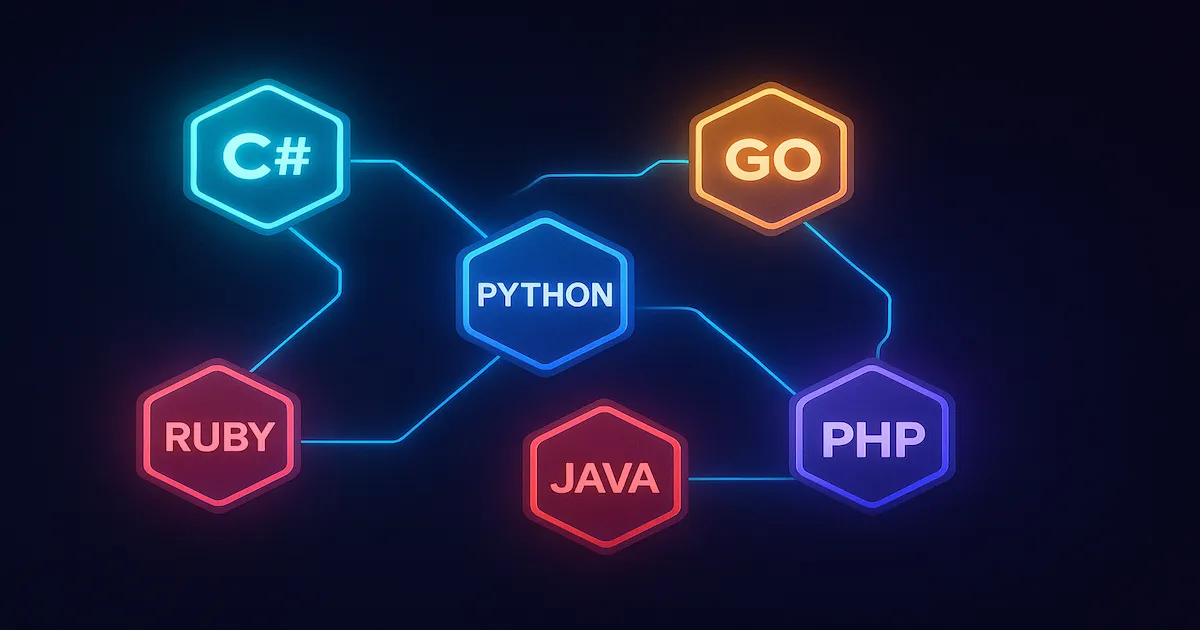
Figure: each language orbits its natural domain — there is no absolute hierarchy, there is context.
After this matrix, the main point I reinforce is: each language optimizes a different axis. C# and Java tend to optimize governance and long-term maintenance. Go tends to optimize operational simplicity and efficient concurrency. Python tends to optimize discovery and the data ecosystem. Ruby and PHP tend to optimize web product speed with excellent pragmatism.
⚠️ Warning: If you turn this table into an absolute ranking, the decision goes wrong. The correct use is to map business priorities and choose the stack that reduces risk in that context.
Decision Framework: Where to Use Each Language
I use a simple framework across six common scenarios.
High-throughput, low-latency APIs
Primary language: Go
Viable alternative: C#
Rationale: Go tends to offer simple operations and good resource efficiency; C# delivers high performance with excellent corporate tooling.
Long-lived corporate systems
Primary language: C# or Java
Viable alternative: Go for platform components
Rationale: strong typing, mature ecosystem, governance and operational predictability.
Internal automation and engineering scripts
Primary language: Python
Viable alternative: Go for single-binary distribution
Rationale: Python speeds up delivery and integrates well with data, APIs and automation.
Data/AI and analytical pipelines
Primary language: Python
Viable alternative: C# or Java for integration services
Rationale: Python’s dominant ML/AI ecosystem, with the possibility of composing with other services in a polyglot architecture.
SaaS product with a lean team
Primary language: Ruby or PHP
Viable alternative: Python (FastAPI/Django)
Rationale: mature frameworks and high iteration speed for web products.
Legacy modernization
Primary language: depends on the dominant legacy
Viable alternative: incremental polyglot architecture
Rationale: migrating everything at once usually increases risk; evolving by domain tends to work better.
Practical Example
To take the discussion out of the realm of opinion, I use a context-weighted decision matrix. Below is a complete Python example that calculates a ranking per scenario with explicit weights.
| |
| |
This example does not “prove” that one language is better in every scenario. It forces criteria transparency. If you change the weights for a web product with a small team, Ruby or PHP will probably rise; for data/AI, Python rises. This makes the decision technically debatable, not ideological.
Tips and Good Practices for a Technical Choice
- Choose by real constraints, not by fashion. I start with SLA, budget, team capacity and regulatory risk. A language is a means to meet constraints, not a goal in itself.
- Run a short POC with business metrics. Instead of debating opinions for weeks, I run a 2 to 4 week proof of concept with clear criteria: delivery time, p95 latency, infrastructure cost and error rate.
- Measure operations from day zero. Without telemetry, any choice looks good in local development. In production, cost and reliability change the game.
- Consider hiring and long-term maintenance. A brilliant stack on paper can become a bottleneck if the local market does not offer enough professionals.
- Avoid a full migration when composition solves the problem. A well-bounded polyglot architecture usually generates more value than rewriting everything to “standardize” without need.
- Define exit criteria before starting. I always document when the choice stops making sense and which signals require a course correction.
📝 Example: A team can keep Python for data pipelines, Go for high-concurrency ingestion services and C# for critical-domain APIs. This reduces risk without forcing artificial homogeneity.
Objective Summary
- C# — combines strong static typing, a mature runtime and high-level tooling, making it excellent for corporate systems with a complex domain and long-term maintenance.
- Go — prioritizes operational simplicity and efficient concurrency with goroutines, making it very suitable for cloud-native services, infrastructure and high-throughput APIs.
- Python — maximizes delivery speed and dominates the data and AI ecosystem, with performance trade-offs in pure CPU-bound workloads when there is no optimization strategy.
- Java — remains highly relevant in the enterprise thanks to the robustness of the JVM, governance and predictability in regulated and mission-critical environments.
- Ruby — delivers high DX and fast product evolution with Rails, especially useful in SaaS with a clear domain and an experienced team.
- PHP — remains competitive in web applications thanks to mature frameworks, broad hosting and excellent cost-effectiveness for time to market.
- Language decision — should be contextual, based on business constraints, team maturity, operational cost and maintenance risk, not on an absolute ranking.
Read Also
- C# as a Script in .NET: How to Use It and When It Pays Off
- pip Is Slow, Poetry Is Complex: UV Arrived to Fix Python
- node_modules Is a Black Hole: Deno and Bun Solved It
- Software Architecture: GoF, Patterns and Microservices
- Parallelism in C#: Parallel, PLINQ and Tasks in Practice
References
- Microsoft Learn - .NET documentation — official documentation for the .NET and C# ecosystem.
- The Go Programming Language Documentation — official guide to the Go language and runtime.
- Python 3 Documentation — official reference for the language and the standard library.
- OpenJDK Documentation — documentation for the Java platform and the evolution of the JVM.
- Ruby Documentation — official reference for the Ruby language.
- PHP Documentation — official documentation for the PHP language.
- TechEmpower Framework Benchmarks — comparative framework benchmark, with interpretation caveats per scenario.
By commenting, you agree to our Privacy Policy, Terms of Use, Data Deletion Policy.